Home Service Franchise Management Software: The 2026 AI-Native Guide
Stop revenue leaks in your network. Our 2026 guide to AI-native home service franchise management software shows how to automate lead recovery and boost prof...

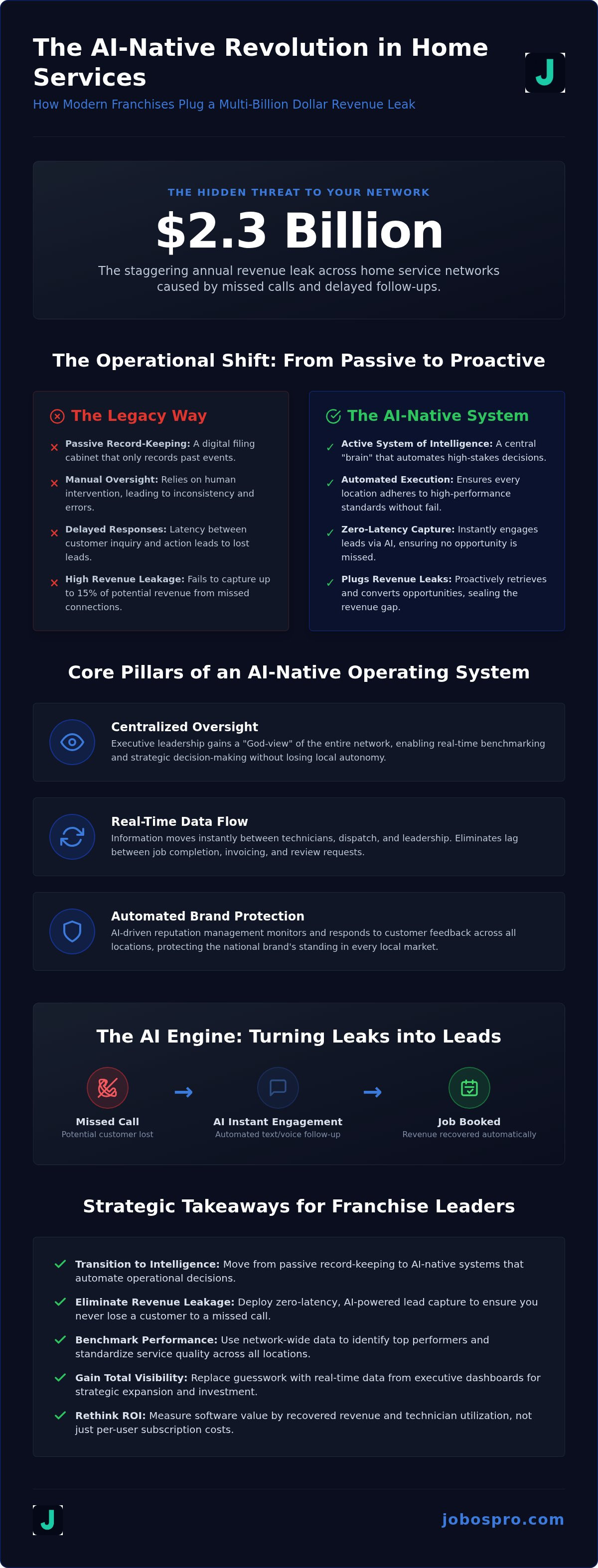
Your franchise network is likely hemorrhaging cash through a gap you can't see. A recent study by JobOS Pro modeled a staggering $2.3 billion annual revenue leak across home service networks caused specifically by missed calls and delayed follow-ups. This isn't just a minor operational friction. It's a systemic failure of legacy home service franchise management software to keep pace with the 2026 consumer's demand for instant response.
You recognize that scaling a multi-location brand requires more than just a proven playbook; it demands absolute consistency that manual oversight can't provide. You're tired of inconsistent service quality and the lack of real-time data for network-wide benchmarking. This guide reveals how transitioning to an AI-native operating system eliminates these invisible leaks and enforces high-performance standards across every zip code in your network. We'll examine the architecture of intelligent dispatching, the mechanics of automated lead recovery, and the benchmarking tools that provide executive-level visibility into every franchise location.
Key Takeaways
- Transition from passive record-keeping to AI-native systems of intelligence that automate high-stakes operational decisions.
- Eliminate revenue leakage by deploying zero-latency lead capture. AI call answering ensures you never lose a customer to a missed connection.
- Leverage home service franchise management software to establish network-wide benchmarks that identify top-performing locations and standardize quality.
- Gain total visibility through executive intelligence dashboards. Real-time data replaces guesswork when making strategic expansion and investment decisions.
- Measure software ROI by focusing on recovered revenue and technician utilization rather than simple per-user subscription costs.
What is AI-Native Home Service Franchise Management Software?
AI-native home service franchise management software represents a fundamental architectural shift in how multi-location businesses operate. It is not a digital filing cabinet or a passive database. Instead, it functions as a centralized "brain" that leverages artificial intelligence to automate the entire customer lifecycle, from initial lead capture to final payment, across hundreds of locations simultaneously. This technology moves beyond simple data storage to provide active, automated oversight that ensures every franchise location adheres to the same high-performance standards.
Home service franchises are uniquely susceptible to revenue leakage. When a customer calls an HVAC or plumbing business, the window for conversion is measured in seconds. If a call is missed or a follow-up is delayed, the lead is lost to a competitor. This is why modern home service franchise management software must act as a system of intelligence rather than a system of record. It proactively retrieves data from every customer interaction to ensure no opportunity is ignored, effectively sealing the multi-billion dollar revenue gap that plagues legacy operations.
From Legacy CRM to AI Operating Systems
Traditional software acts as a passive observer. It records what happened after a human manually enters the data. In contrast, an AI business management for home services approach treats software as an active participant. Research indicates that legacy systems often fail to capture up to 15% of potential revenue before a call even concludes because they lack real-time response capabilities. AI call answering and instant lead capture solve this by replacing manual entry with immediate, automated action. The software doesn't just store the lead; it engages it, schedules it, and prepares the technician for the job without human intervention.
Core Pillars of Modern Franchise Tech
Success within the franchise business model depends on brand consistency and operational uniformity. Modern platforms achieve this through three core pillars:
- Centralized Oversight: Executive leadership gains a "God-view" of the entire network, allowing for decentralized execution at the local level without losing control over quality.
- Real-Time Data Flow: Information moves instantly between technicians, dispatchers, and owners. There is no lag between a job being completed and an invoice being sent or a review being requested.
- Automated Brand Protection: AI-driven reputation management monitors and responds to customer feedback across all locations, protecting the national brand's standing in every local market.
By unifying these elements, a franchise can scale rapidly without the typical friction associated with multi-location expansion. The software ensures that the 50th location operates with the same precision and efficiency as the first.
Eliminating Latency: The AI-Driven Lead and Dispatch Engine
Operational latency is the primary barrier to scaling a multi-location network. In the home services sector, the gap between a customer's inquiry and a technician's arrival is where revenue evaporates. Modern home service franchise management software must do more than just record these gaps; it must eliminate them through an AI-driven engine that operates at sub-second speeds. By automating lead capture and technical scheduling, franchises can achieve a level of responsiveness that human dispatchers simply cannot match.
Zero-Latency Lead Capture
The cost of a missed call isn't just the price of a single job. It's the lifetime value of a customer handed directly to a competitor. AI missed-call recovery transforms this vulnerability into a competitive advantage. When a call goes unanswered, the system instantly engages the lead via text or automated voice, qualifying the issue and booking the appointment. This ensures that the revenue leaks identified in industry models are plugged at the source. Automated lead management further refines this process by scoring leads and routing them to the appropriate franchise territory without manual oversight. This speed to lead becomes your most potent weapon in a crowded local market.
Smart Dispatch and Technician Utilization
Scaling profitability requires more than just more jobs; it requires better utilization of the technicians you already have. The implementation of intelligent technician dispatching ensures that the right professional is sent to the right job based on skill sets, real-time location, and current truck inventory. When Evaluating franchise agreements and operational costs, the efficiency of your field force is a critical metric for long-term viability. AI-driven scheduling accounts for high-priority emergency calls while maintaining the steady flow of maintenance memberships, maximizing revenue per hour worked.
Dynamic route optimization reduces fuel expenditures and prevents technician burnout by minimizing unnecessary travel time. For the franchise manager, this provides real-time visibility into technician performance and job status across the entire network. If you want to see how these automated systems can transform your bottom line, consider how JobOS Pro unifies these disparate functions into a single, high-performance operating system. The result is a frictionless operation where lead loss is eliminated and technician efficiency is mathematically optimized.
Franchise Network Benchmarking and Executive Intelligence
Managing a multi-location network without a unified intelligence layer is an exercise in blind trust. While legacy systems offer basic reporting, true growth requires the comparative depth found in franchise network benchmarking software. This technology identifies why Location A outperforms Location B by isolating specific variables like technician utilization, lead-to-close ratios, and average ticket size. By standardizing these KPIs across your entire footprint, you establish a high-performance floor that every franchisee must meet.
As we analyze Franchise Industry Trends in 2026, it's clear that the home service sector is moving toward predictive resource management. Modern home service franchise management software now uses AI to anticipate seasonal demand spikes before they occur. This allows leadership to reallocate marketing spend or technician capacity between regions, ensuring that no territory is overwhelmed while another sits idle. It's a strategic shift from reactive management to proactive network optimization that ensures capital is always deployed where it has the highest impact.
Executive Dashboards for Strategic Oversight
Strategic oversight requires a single pane of glass. High-level executive dashboards for home services provide this by aggregating disparate data points into actionable insights. You can drill down from national revenue trends to the performance of a single technician in a specific zip code. This granularity ensures that capital is allocated where it generates the highest return, rather than being distributed based on anecdotal evidence or outdated spreadsheets. It provides the total visibility required to lead a modern, data-driven organization.
Standardizing Quality with AI Guardrails
Maintaining a national brand's reputation requires uniform execution across every touchpoint. AI guardrails enforce these standards by automating follow-ups and review requests, ensuring every customer receives a 5-star experience regardless of which franchise location they contact. The software also enforces uniform pricing and service protocols through AI estimating tools, preventing the brand erosion caused by inconsistent local quotes. If a location's performance falls below network benchmarks, the system triggers proactive alerts. This allows for immediate corrective action before a local dip becomes a national liability.
Evaluating Franchise Software: Scalability, ROI, and Adoption
Selecting home service franchise management software is a high-stakes strategic decision that dictates your network's growth ceiling. Legacy providers often emphasize the size of their user base, yet their implementation cycles can drag on for months. This delay represents a significant opportunity cost for new franchisees who need to generate cash flow immediately. In the 2026 market, the primary criteria for evaluation must shift from a mere list of features to the speed of implementation and the depth of AI integration. A platform that takes a quarter to deploy is a liability; a platform that scales instantly is an asset.
Calculating the ROI of an AI-native system requires looking beyond monthly subscription fees. You must account for revenue recovery from eliminated missed calls and the efficiency gains found in optimized technician routes. When you examine the 2026 best HVAC franchise software, the differentiator is how the technology reduces the cognitive load on the franchisee. AI-native tools are inherently easier to adopt because they automate the complex data entry that technicians and office staff typically resist. High adoption rates lead to better data, which in turn leads to more accurate network-wide benchmarking.
The True Cost of Inefficient Software
Invisibility is expensive. Software that lacks automated lead recovery allows revenue to leak through every missed connection. Manual invoicing processes create payment delays that strain franchisee cash flow. Furthermore, poor scheduling tools are a leading cause of technician turnover. When technicians are frustrated by inefficient routes or missing job information, they leave for competitors with better tech stacks. "Cheap" legacy software often carries the highest price tag in the form of lost growth opportunities and high talent churn.
Future-Proofing Your Franchise Network
Your software stack must be AI-native to remain competitive in 2026. This means the system doesn't just store data; it acts on it. Integration requirements are non-negotiable. Your platform must communicate seamlessly with QuickBooks, industry-standard payment processors, and modern marketing tools. Beyond the technical requirements, you are preparing your franchisees for a data-driven operational culture. This shift requires a platform that provides clear, actionable insights rather than overwhelming users with raw numbers. If you are ready to eliminate operational friction and secure your network's future, book a demo of JobOS Pro to see the AI Operating System in action.
Scaling Your Home Service Empire with JobOS Pro
JobOS Pro is not a peripheral tool; it is the foundational layer of a modern business stack. It provides the AI Operating System necessary to manage complex, multi-location trades with surgical precision. By unifying AI call answering, intelligent dispatching, and automated billing, the platform eliminates the disparate data silos that traditionally hinder expansion. This is the only home service franchise management software designed to move as fast as your growth ambitions. It replaces the chaos of manual oversight with a silent, tireless worker that provides constant oversight across every territory.
Consider the trajectory of networks that have scaled from 5 to 50 locations using this architecture. In a legacy environment, such growth usually requires a linear increase in office staff to manage the administrative burden of dispatching and lead follow-up. With JobOS Pro, these networks achieve a tenfold expansion in footprint without doubling their headcount. The AI handles the high-stakes work of lead recovery and scheduling, allowing your leadership team to focus on strategic market acquisition rather than fighting fires. This represents a foundational technological shift in how home service empires are built and sustained.
The JobOS Pro Advantage for Franchises
The platform's AI-native architecture learns your operational patterns in real-time, optimizing your business while you sleep. It offers unrivaled executive reporting that goes beyond basic metrics to provide deep network benchmarking. Whether you're managing HVAC, plumbing, or electrical trades, JobOS Pro understands the specific nuances of your industry. It retrieves hidden patterns in technician performance and customer retention that human operators miss, providing the competitive edge required to dominate your local markets. You gain a sophisticated layer of intelligence that ensures every franchisee adheres to your brand's high-performance standards.
Take Control of Your Network Growth
Your current software is likely the primary bottleneck in your expansion strategy. If you don't have total visibility into your revenue leakage or technician utilization, you're operating at a deficit. It's time to audit your operational intelligence gap and replace outdated systems with a platform built for the future. Request a strategic audit of your franchise's efficiency and see the AI Operating System in action through a custom demo. This is the definitive choice for leaders who refuse to settle for systemic inefficiency. Book your executive consultation with JobOS Pro today.
Securing Your Network's Competitive Edge
The transition to AI-native home service franchise management software is a survival imperative for the 2026 market. You've seen how legacy systems act as passive observers while revenue leaks through missed calls and inefficient dispatching. By adopting a system of intelligence, you reclaim lost capital and enforce a standard of excellence across every location. Strategic growth is no longer limited by your ability to hire office staff; it's dictated by the speed of your operational data.
You now have the roadmap to eliminate latency and standardize performance. JobOS Pro provides the foundational AI-native lead capture and dispatching required to outpace local competition. With executive benchmarking for multi-location growth and automated invoicing and payment collection, you gain total visibility into your empire's health. It's time to replace systemic friction with automated precision. Scale your franchise with the JobOS Pro AI Operating System. The future of the trades belongs to the leaders who choose to automate today.
Frequently Asked Questions
What is the difference between a standard CRM and franchise management software?
Franchise management software provides multi-location oversight and benchmarking that a standard CRM lacks. While a CRM handles individual customer relationships, franchise-specific platforms unify data across a national network to ensure brand consistency. They allow executive leadership to observe performance trends across dozens of territories from a single interface, making them essential for scaling multi-location operations.
How does AI actually stop revenue leakage in a home service business?
AI stops revenue leakage by automating the response to missed calls and abandoned leads instantly. In the home services sector, a delay of even five minutes can lead to a lost booking. AI call answering recovers these leads by engaging the customer immediately through text or voice; this ensures that potential revenue is captured before the customer contacts a competitor.
Can AI-native software integrate with our existing accounting tools like QuickBooks?
Yes, JobOS Pro is designed to integrate seamlessly with QuickBooks to maintain financial accuracy. The software automates the flow of invoicing and payment data directly into your accounting system. This eliminates the need for manual data entry, reducing human error and ensuring that your franchise network's financial records are updated in real-time across all locations.
Is AI too difficult for my technicians and franchisees to learn?
AI-native home service franchise management software is actually easier to learn because it automates the repetitive data entry that technicians typically resist. By using intelligent voice-to-text and automated scheduling, the software reduces the cognitive load on field staff. Most franchisees find that the intuitive interface requires less training than legacy systems because the intelligence handles the complex backend logic automatically.
How does franchise benchmarking software help increase the value of my network?
Benchmarking software increases network value by identifying top-performing locations and isolating the variables that drive their success. When you can mathematically prove that your operational playbook works across diverse markets, the enterprise value of the franchise brand rises. It provides potential investors with clear, data-backed evidence of a scalable and predictable business model that minimizes operational risk.
What specific trades is JobOS Pro designed for?
JobOS Pro is engineered specifically for high-demand residential and commercial trades. This includes HVAC, plumbing, electrical, pest control, and landscaping companies. The platform's logic is built around the unique workflows of these industries, such as emergency dispatching and recurring maintenance memberships, making it a specialized home service franchise management software solution for trade professionals.
How long does it take to implement an AI operating system across multiple locations?
Implementation typically takes between two to four weeks depending on the size of the franchise network. Unlike legacy enterprise systems that require months of configuration, AI-native platforms are designed for rapid deployment. The software retrieves existing data and maps it to new workflows quickly, allowing your franchisees to start capturing recovered revenue and optimizing technician routes almost immediately.
What are the core metrics an executive dashboard should track for home services?
Executive dashboards should prioritize metrics that reflect network-wide health and efficiency. Key data points include revenue per technician, lead-to-close ratios, and average ticket size across all territories. You should also monitor technician utilization rates and customer retention numbers. These metrics allow leadership to identify which locations need additional support and where capital should be allocated for maximum growth.
Ready to stop losing jobs to voicemail?
JobOS Pro's Kate AI responds to every missed call within 47 seconds — 24/7, no staff required. Start free, no credit card needed.