
Franchise Network Benchmarking Software: The 2026 Strategic Guide
Discover how franchise network benchmarking software uses AI to provide real-time operational intelligence, boosting profitability and unifying your entire n...

If your franchise network is only reporting revenue once a month, you aren't managing a business; you are reading a history book. Relying on lagging financial indicators creates a dangerous gap between identifying a systemic failure and correcting it. Implementing advanced franchise network benchmarking software is no longer a luxury reserved for the industry elite. It's the foundational requirement for any multi-unit operator who demands total oversight. You already know the cost of inconsistent service quality and the silent drain of revenue leakage at the intake level. It's time to replace those blind spots with a unified intelligence layer.
This strategic guide demonstrates how AI-driven operational benchmarking transforms franchise performance from reactive reporting into a proactive growth engine. You'll discover how to achieve total visibility into network operations and use automated systems to identify your top-performing locations instantly. We'll examine the technical shift toward real-time data that improves bottom-line profitability by observing and correcting technician performance as it happens. From identifying hidden patterns to unifying disparate data points, this is the definitive blueprint for the 2026 franchise landscape.
Key Takeaways
- Transition from retrospective accounting to real-time operational intelligence to identify systemic inefficiencies before they erode your margins.
- Leverage AI as your primary data collector to capture critical front-end metrics like lead response times and call conversion rates across the network.
- Deploy franchise network benchmarking software to establish unified "North Star" metrics that align every branch with your highest-performing locations.
- Move beyond lagging financial indicators to prioritize the operational leading indicators that actually drive franchise scalability and terminal value.
- Eliminate revenue leakage by consolidating lead capture, dispatching, and billing into a single, AI-native intelligence layer for total visibility.
What is Franchise Network Benchmarking Software?
It's the intelligence layer that transforms raw data into a competitive advantage. At its core, franchise network benchmarking software is a centralized platform that aggregates performance data across every location in a network to establish rigorous standards and identify operational outliers. For years, franchisors relied on retrospective accounting, looking at bank statements to judge success. That era is over. Modern software prioritizes real-time operational intelligence, observing the "how" of the business before the "what" appears on a balance sheet. This technology retrieves information from every corner of the enterprise, unifying it into a single, authoritative view of the entire network.
To understand the foundation of this process, one might ask: What is Benchmarking? In a modern context, it's the systematic comparison of organizational processes and performance metrics to industry bests and best practices from other companies. For a franchise, this means comparing your top 10% of performers against the bottom 10% to find the exact friction points in your service delivery. Home service franchises, such as HVAC and plumbing companies, require these specialized tools because their operations are decentralized and high-velocity. You cannot manage what you cannot see, and without a unified software layer, you're effectively flying blind.
The Core Purpose of Modern Benchmarking
Standardizing the customer experience is the primary objective. Whether a technician is in Seattle or Miami, the brand promise must remain identical. Benchmarking software ensures this by tracking specific KPIs like lead response times and average ticket values. It allows executive leadership to identify revenue leakage before it impacts financial statements, catching missed calls or poor conversion rates in real time. This creates a culture of healthy competition. When franchisees see how they rank against their peers through strategic visualization, performance naturally trends upward. It turns abstract goals into concrete, visible targets that every branch manager can understand.
Why Legacy Spreadsheets are Failing Multi-Unit Owners
Stale data is the enemy of growth. In high-velocity home service markets, yesterday's numbers are already obsolete. Legacy spreadsheets are riddled with manual entry errors and lack a "Single Source of Truth" that executive leadership can trust. They cannot provide the real-time, cross-location comparisons required for rapid decision-making. Basic CRMs often fall short here too; they track individual jobs but fail to synthesize network-wide patterns. Multi-location owners need a sophisticated layer that retrieves and unifies disparate data points into a single, actionable dashboard. If your data requires manual manipulation before it's useful, it's already too late to act on it.
The 2026 Shift: AI-Driven Operational Intelligence
Data is the fuel. AI is the engine. In 2026, the most successful multi-unit operators have abandoned the practice of manual data entry in favor of automated, AI-native retrieval systems. Modern franchise network benchmarking software no longer waits for a manager to upload a spreadsheet; it observes every call, every dispatch, and every invoice in real time. This shift represents a move from passive observation to active operational intelligence. By leveraging AI as the primary data collector, executive leadership gains an unfiltered view of the "front-end" of their business, where revenue is either captured or lost. Traditional methods of franchise performance benchmarking often missed these granular interactions, but today's technology ensures no lead is left unobserved.
The feedback loop is now fully automated. When AI retrieves data from the point of impact, it can immediately categorize performance and generate executive reports without human intervention. This eliminates the bias often found in self-reported data from individual branches. It allows you to see the reality of your operations, providing a clear path to corrective action. If you're ready to modernize your oversight, exploring an AI-native platform like JobOS Pro is the logical next step for your enterprise stack.
Automated Lead Capture as a Benchmark
In the home service industry, speed is the only currency that matters. Benchmarking lead response latency across your entire network reveals which locations are capitalizing on your marketing spend and which are letting opportunities wither. AI call analysis provides deep insights into call-to-booking ratios, identifying exactly where dispatchers or CSRs are failing to convert. AI missed-call recovery transforms franchise intake data by instantly capturing lost opportunities and turning them into measurable, recoverable revenue events. This level of detail allows you to establish a network-wide gold standard for customer acquisition that isn't based on guesswork.
Technician Dispatching and Field Efficiency
Field efficiency is the heartbeat of profitability. By comparing drive-time and on-site efficiency across different territories, you can pinpoint systemic delays that are invisible to the naked eye. Identifying your top-performing technicians allows you to reverse-engineer their success, creating a blueprint that can be replicated across every branch. Integrating intelligent technician dispatching into your benchmarking stack ensures that your field operations are optimized for maximum utilization. This technology doesn't just track where your trucks are; it unifies dispatching data with performance metrics to ensure the right technician is always sent to the right job for the best possible margin.
Financial vs. Operational Benchmarking: A Comparison
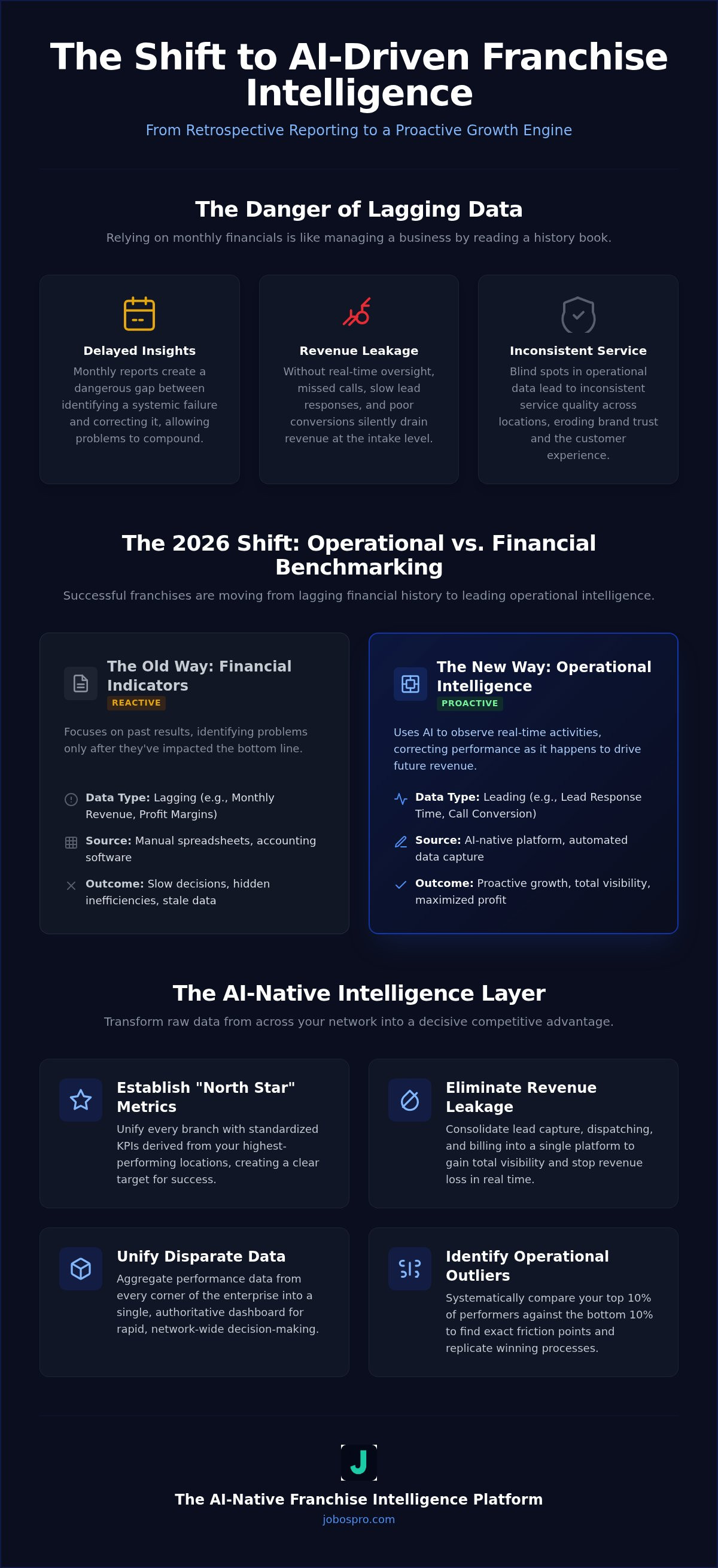
Most franchise executives are obsessed with the Profit and Loss statement. While the P&L is the ultimate scorecard, it's also a lagging indicator that only reveals the consequences of past actions. Relying solely on financial data is like trying to drive a vehicle while looking exclusively at the rearview mirror. To achieve sustainable growth in the high-stakes home service sector, you must shift your focus toward the operational leading indicators that predict future financial health. This is where advanced franchise network benchmarking software provides its greatest value, offering a holistic view of the network that connects daily activities to terminal profitability.
Lagging Indicators: The Financial View
Financial benchmarking typically centers on revenue per location, profit margins, and royalty tracking. These metrics are essential for accounting, but they're fundamentally retrospective. They tell you that a branch is failing, but they don't tell you why. In many cases, high revenue can mask significant operational rot. A location might be generating impressive top-line numbers while simultaneously suffering from bloated labor costs or catastrophic customer churn. Without operational context, these inefficiencies remain hidden until they eventually erode the bottom line beyond the point of easy correction.
Leading Indicators: The Operational View
Operational benchmarks are the early warning system for your franchise network. By tracking metrics like lead capture rates, average ticket size, and technician utilization, you can observe the health of a business in real time. Standardizing these processes across multiple territories requires a foundational AI business management for home services layer that retrieves and unifies data from every job site. This proactive approach allows for mid-month course corrections that financial reporting simply cannot support.
- Lead Capture Rates: Identifying which branches are failing to answer the phone before the marketing budget is wasted.
- Average Ticket Size: Spotting discrepancies in sales performance and technician training across different regions.
- Technician Utilization: Measuring the actual time spent on revenue-generating tasks versus idle travel time.
When you unify these leading indicators, you create a predictive model for your network. You'll know which locations will hit their targets weeks before the month ends. This level of oversight turns benchmarking from a compliance chore into a strategic weapon for aggressive expansion.
Implementing a Benchmarking Strategy Across Your Network
Execution is where strategy meets reality. To deploy franchise network benchmarking software successfully, you must establish a "North Star" metric that aligns every stakeholder from the corporate office to the field. Data integrity is the non-negotiable foundation of this process. If your locations are running on fragmented, legacy systems, your benchmarking data is essentially a collection of sophisticated guesses. You require a unified operating system that retrieves and unifies data points automatically, ensuring that the information reaching your desk is both accurate and actionable. Without this foundational layer, your oversight remains performative rather than transformative.
Consistency across 50 locations is difficult; consistency across 500 is impossible without the right technology. Training your franchisees to use this data for local improvements is just as critical as the data collection itself. When every branch manager understands how their specific performance impacts the network-wide average, they move from being passive operators to active participants in the brand's growth. This systemic alignment is what separates market leaders from those struggling with inconsistent service quality.
Selecting the Right Performance Metrics
Focusing on too many variables leads to operational paralysis. You must identify 3-5 "Vital Signs" that every franchisee is required to track with absolute precision. While top-line revenue is the obvious choice, it's often the least helpful for identifying operational rot. A modern strategy must include customer retention rates and reputation management scores to gauge long-term brand health. Utilizing executive dashboards for home services allows you to monitor these metrics in real time, providing the visibility needed to intervene before a local dip becomes a systemic crisis. These dashboards turn abstract goals into a visible, competitive leaderboard that drives performance across the entire network.
Overcoming Franchisee Resistance to Oversight
Transparency often meets friction. Many franchisees initially view increased visibility as a surveillance tool designed to penalize underperformance. You must reframe this perception. Position the implementation of franchise network benchmarking software as a support mechanism that identifies exactly where a branch needs help to increase its own profitability. By sharing "Best Practice" insights derived from your top-performing locations, you demonstrate the tangible value of the data. When a franchisee sees that their peers are achieving higher margins through better lead response times, the data becomes a roadmap for their own success. This creates a transparent environment where data, rather than intuition or ego, drives every major business decision.
If you are ready to eliminate the blind spots in your network and empower your franchisees with actionable intelligence, explore how JobOS Pro unifies your franchise operations through AI-native benchmarking.
The JobOS Pro Advantage: AI-Native Franchise Intelligence
Strategic oversight requires more than just access to data; it requires a unified architecture designed for action. JobOS Pro functions as the definitive intelligence layer for the modern home service enterprise. While legacy systems offer fragmented integrations that often fail to communicate, this platform unifies lead capture, intelligent dispatching, and automated billing into a single, cohesive environment. This is the next evolution of franchise network benchmarking software. It moves beyond the passive observation of metrics and enters the territory of automated operational correction. By observing every interaction at the intake level, JobOS Pro identifies revenue leakage in real time, allowing you to salvage opportunities that would otherwise be lost to the void of manual errors.
Scalability is the core DNA of the platform. Built specifically for the complexities of multi-location home service networks, it provides the robust infrastructure needed to manage hundreds of territories without a proportional increase in administrative burden. It transforms benchmarking from a static report into a dynamic engine for growth. By automating the transition from data capture to field execution, you ensure that every branch operates at peak efficiency regardless of local management styles. This high-stakes environment demands a system that retrieves and unifies data points without human intervention, and JobOS Pro delivers that level of technical sophistication.
Standardizing the Network with JobOS Pro
Consistency is the hallmark of a dominant franchise. JobOS Pro creates a uniform operating environment that forces every franchisee to adhere to your proven success models. It automates the collection of critical operational KPIs, effectively eliminating the need for manual reporting or self-reported data that can be prone to bias. This automation significantly reduces the executive overhead required to manage 50 or more locations. Instead of spending hours retrieving disparate data points, your leadership team can focus on high-level strategy and network expansion. You gain the power of total oversight without the traditional costs of manual monitoring.
Predictive Growth for Franchisors
The historical data retrieved by JobOS Pro serves as a blueprint for your future. By analyzing deep benchmarking data, you can predict future network expansion with surgical precision. The platform identifies the "ideal" franchisee profile by isolating the data-driven success patterns found in your top-performing locations. This allows you to recruit and train new partners based on hard evidence rather than intuition. Using franchise network benchmarking software in this capacity turns your operational history into a predictive asset. JobOS Pro eliminates the gap between data and execution by turning raw operational insights into immediate, automated field actions.
Securing Your Competitive Edge Through Operational Oversight
The era of managing by intuition has ended. High-growth home service franchises now require an intelligence layer that observes and corrects performance in real time. By prioritizing leading operational indicators over lagging financial reports, you gain the ability to stop revenue leakage before it manifests on a balance sheet. Implementing advanced franchise network benchmarking software is the only way to ensure total visibility across a decentralized network. JobOS Pro provides the AI-native operational benchmarking and real-time executive performance dashboards necessary to scale with precision. It's time to unify your lead capture, dispatching, and billing into a single, authoritative source of truth. Optimize Your Franchise Network with JobOS Pro Intelligence. You have the blueprint; now you need the technological engine to drive it forward. Your network's potential is only limited by the level of visibility you choose to maintain.
Frequently Asked Questions
What is the difference between franchise management software and benchmarking software?
Franchise management software focuses on the daily execution of tasks like scheduling, billing, and customer records at the branch level. In contrast, franchise network benchmarking software acts as a sophisticated intelligence layer that aggregates this data to identify performance gaps and establish system-wide standards. It moves beyond individual task management to provide a comparative analysis that reveals which locations are underperforming relative to the network average.
How often should a franchise network update its benchmarking data?
The 2026 standard for data updates is real-time. Lagging monthly reports are insufficient for high-velocity home service markets where operational shifts happen every hour. Automated systems retrieve and unify data continuously; this allows executive leadership to make mid-week course corrections before a minor inefficiency becomes a terminal financial loss on the monthly balance sheet.
Can benchmarking software help reduce revenue leakage in HVAC or plumbing businesses?
Benchmarking tools are specifically designed to isolate friction points in the intake and dispatch process. By observing call-to-booking ratios and lead response times, the software identifies exactly where revenue is slipping through the cracks. For HVAC and plumbing businesses, this often means capturing missed calls or identifying technicians who consistently fail to convert estimates into paid jobs.
Is benchmarking data anonymous for individual franchisees?
Transparency levels are typically determined by the franchisor's strategic goals and internal culture. While executive leadership maintains total visibility, data shared with individual franchisees is often anonymized to foster a culture of healthy competition without compromising specific privacy. This allows branches to see how they rank against top performers while focusing on their own operational improvement.
What are the most important operational KPIs for a home service franchise?
The most critical indicators are lead response latency, booking conversion rates, average ticket size, and technician utilization. These metrics provide a leading view of the business health. Financial numbers tell you what happened; these operational KPIs tell you what will happen to your margins in the coming weeks based on current field performance.
How does AI improve the accuracy of franchise network benchmarking?
AI eliminates the inherent bias and error of manual data entry by retrieving information directly from call recordings and dispatch logs. It ensures the data is an objective reflection of reality rather than a curated report from a branch manager. By analyzing natural language in customer interactions, AI can accurately categorize lead quality and technician performance without requiring human intervention.
Can benchmarking software integrate with existing accounting tools like QuickBooks?
Modern franchise network benchmarking software is built to integrate seamlessly with standard accounting tools like QuickBooks. This connection is vital for reconciling operational activity with actual financial results. It ensures that your benchmarking data isn't just a set of abstract numbers but a verified driver of bottom-line profitability across all locations.
What is the ROI of implementing specialized franchise benchmarking software?
The return on investment stems from the immediate recovery of lost revenue and the long-term standardization of high-performance behaviors. By identifying and correcting a gap in booking rates or reducing idle drive time, the software pays for itself through reclaimed margins. It turns your franchise network into a precision-tuned engine for consistent, predictable growth.
Ready to stop losing jobs to voicemail?
JobOS Pro's Kate AI responds to every missed call within 47 seconds — 24/7, no staff required. Start free, no credit card needed.