Automated Lead Management for Contractors: 2026 Guide
Stop losing leads. Our guide to automated lead management for contractors shows how AI can boost bookings by 78% and eliminate costly response delays.

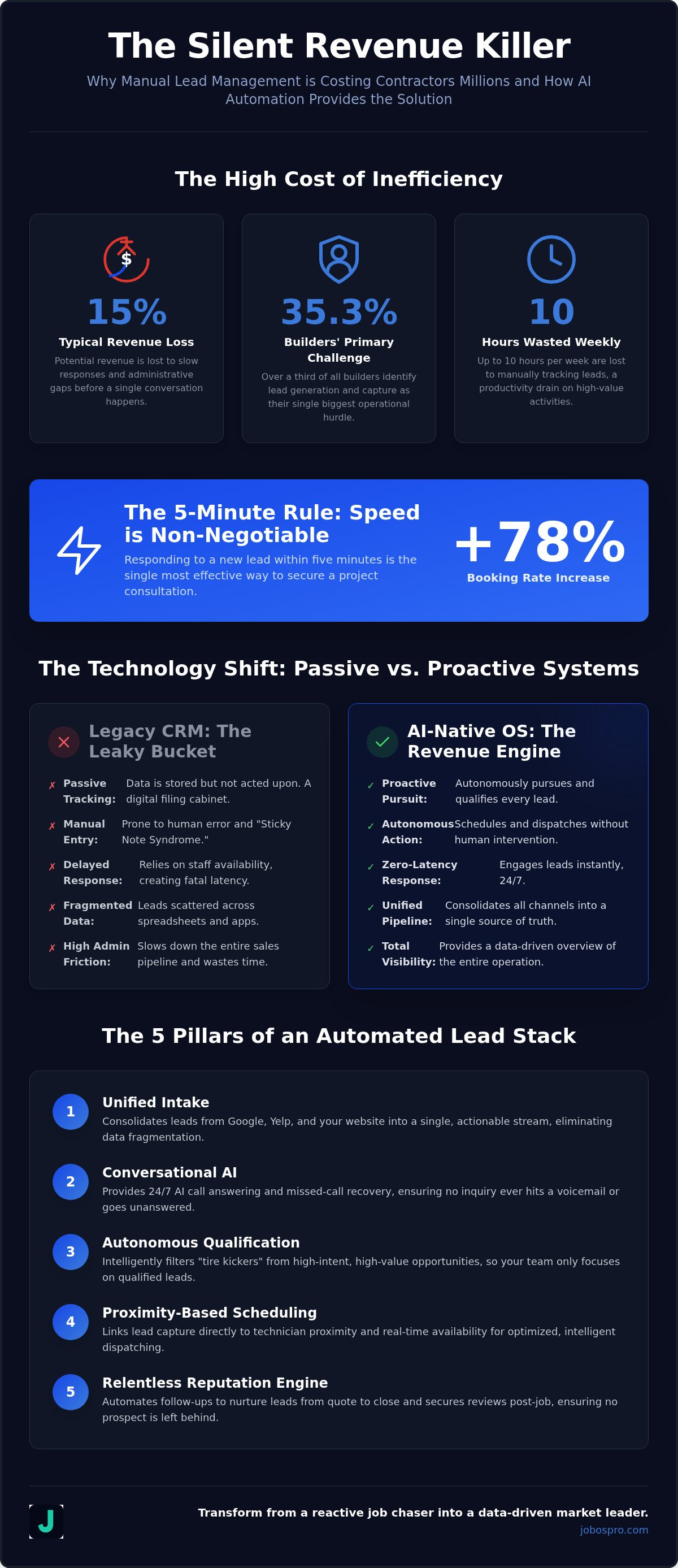
Firms that trigger automated AI follow-up sequences within five minutes of a prospect's inquiry see project consultation booking rates jump by 78 percent. In a market where 35.3 percent of builders identify lead generation as their primary challenge, the real failure isn't a lack of interest; it's the latency of the response. You've likely felt the sting of a missed call or the silence of a lead that went cold because your data was trapped in a spreadsheet. It's an expensive way to run a business, and it's entirely preventable through modern innovation.
This guide demonstrates how to deploy automated lead management for contractors to stop revenue leakage and reclaim hours of wasted administrative time. You'll discover how AI-native systems replace passive legacy CRMs to create a unified, self-correcting pipeline. We will break down the transition from manual dispatching to an intelligent architecture that ensures an instant response to every inquiry, transforming your operations into a high-performance engine that operates with total visibility and precision.
Key Takeaways
- Identify the systemic inefficiencies of manual intake and how autonomous systems capture and qualify leads without human intervention to stop the $2.3B industry revenue leak.
- Learn why implementing automated lead management for contractors is the only way to achieve zero-latency response times and eliminate the 15 percent revenue loss typical of manual operations.
- Understand the critical distinction between passive legacy CRMs and proactive AI-native operating systems that handle real-time dispatching and decision-making autonomously.
- Follow a strategic implementation roadmap to secure your business's front door using intelligent AI call answering and unified intake channels from Google and Yelp.
- Discover how to scale your home service business without increasing administrative overhead by transforming from a reactive job chaser into a data-driven market leader.
The Silent Revenue Killer: Why Manual Lead Management Fails in 2026
In 2026, manual lead management isn't just inefficient; it's a structural liability. Automated lead management for contractors is an autonomous architecture that captures, qualifies, and schedules appointments without human intervention. It operates as a silent intelligence layer. It never sleeps, never forgets to follow up, and never lets a qualified prospect slip through the cracks of a busy office schedule. This shift from manual to machine-driven intake is no longer optional for firms looking to maintain market dominance.
Industry data reveals a staggering "$2.3B Leak" across the home services sector. Businesses typically lose 15 percent of their potential revenue before a single conversation concludes. This happens because the "leaky bucket" of manual intake cannot contain the volume of modern demand. Consumers in 2026 don't just prefer digital interaction; they demand it. They expect 24/7 availability and zero-latency responses. If your business isn't available at 11:00 PM on a Tuesday, they'll find a competitor who is. The psychological shift toward instant gratification has made the traditional "we'll call you back tomorrow" model obsolete.
Traditional software relies on "Passive Tracking." You enter data, and it sits in a database. This is a far cry from modern lead management principles that prioritize active recovery. An AI-native operating system doesn't just store a lead; it pursues it. It identifies the intent behind an inquiry and takes immediate action to secure the booking. This proactive layer ensures that your sales pipeline is an active revenue engine rather than a static digital filing cabinet.
The True Cost of a Missed Call
Every missed call represents wasted Customer Acquisition Cost (CAC). When a lead hits voicemail, your marketing spend effectively evaporates. In high-urgency trades like HVAC or plumbing, the "First-to-Respond" advantage is absolute. Research shows that responding within five minutes increases consultation booking rates by 78 percent. Beyond the immediate job loss, these failures erode brand reputation and slash long-term Customer Lifetime Value (LTV). A customer who can't reach you during an emergency won't call you for their next planned project.
Fragmented Data and Administrative Friction
Multi-location enterprises often suffer from "Sticky Note Syndrome." Lead data is scattered across spreadsheets, physical notes, and disparate apps. This fragmentation creates immense administrative friction that slows down the entire organization. Most construction firms waste 6 to 10 hours per week manually tracking leads. This is a productivity drain that prevents your team from focusing on high-value closing activities. Revenue leakage is the invisible loss of earned income resulting from uncaptured inquiries, slow response times, and administrative gaps within the sales pipeline.
The 2026 Automated Lead Stack: 5 Essential Components for Contractors
Success in the current market requires more than a collection of disconnected apps. It demands a unified technological architecture. A high-performance stack for automated lead management for contractors must function as a single, cohesive unit that observes every entry point and retrieves every opportunity. This isn't about software that stores data; it's about an intelligence layer that executes actions in real-time. To dominate your local market, your stack must integrate five foundational pillars: unified intake, conversational AI, autonomous qualification, proximity-based scheduling, and a relentless reputation engine.
Unified intake consolidates leads from Google Local Services, Yelp, and your website into a single stream of truth. From there, autonomous qualification filters the "tire kickers" from high-intent emergency calls, ensuring your office staff only touches the highest-value opportunities. This is followed by intelligent scheduling that links lead capture directly to technician proximity and real-time availability. Finally, the reputation engine automates follow-ups to nurture leads from quote to close, ensuring no prospect is left in limbo. This systematic approach eliminates the guesswork that plagues traditional home service operations.
AI Call Answering and Missed-Call Recovery
Office staff cannot scale with call volume during peak seasons without incurring massive overhead. AI call answering provides the solution by handling high-volume periods with zero latency. When a technician is on-site and unable to pick up, instant text-back automation engages the prospect immediately. This ensures you never lose a job to a competitor simply because you were busy working. You can explore the mechanics of this in our contractor lead capture guide to stopping revenue leakage. It's about securing the front door of your business through constant, intelligent availability.
Automated Estimating and Quoting
Speed is the primary currency of trust in 2026. Reducing the time-to-quote from days to minutes using AI-driven templates creates an immediate professional advantage. When a prospect receives a polished, accurate quote while the competitor is still "checking their schedule," the choice becomes obvious. These automated systems increase your professional image while simultaneously reducing administrative friction. For a deeper look at these capabilities, consult The Definitve Guide to HVAC Sales Automation Software in 2026. Implementing these systems allows you to move at the speed of modern demand.
Transitioning to an AI-powered operating system ensures these components work in harmony to drive growth without increasing your headcount.
Legacy CRM vs. AI-Native Operating Systems: A Strategic Comparison
Most contractors mistake a digital filing cabinet for a growth strategy. Legacy CRMs are designed for storage, not execution. They excel at holding customer names and historical data, yet they remain fundamentally passive. In contrast, automated lead management for contractors requires an AI-native operating system that functions as a proactive participant in your business. This technology doesn't just wait for data entry; it observes incoming signals and retrieves revenue opportunities autonomously.
The "Integration Tax" is the hidden cost of a fragmented tech stack. Many firms attempt to duct-tape disparate apps together using third-party connectors like Zapier. This creates a fragile architecture where data latency is inevitable and system failures are common. A unified AI-native OS eliminates this friction by housing intake, dispatching, and reporting within a single intelligence layer. It moves your organization away from "Passive Tracking" toward "Active Recovery," ensuring that every lead is handled with machine-level precision rather than human-level inconsistency.
Why Your Current CRM is a Growth Bottleneck
True automation does not require a human click. If your staff must manually trigger a follow-up or move a lead through a pipeline stage, you don't have an automated system; you have a digital chore list. Legacy systems fail to provide the cross-location intelligence necessary for scaling franchises or multi-unit enterprises. They isolate data, making it impossible to identify systemic performance gaps across different markets. Transitioning to JobOS Pro provides the foundational AI business management for home services required to break these bottlenecks and achieve true operational autonomy.
The Intelligence Layer: Executive Oversight in 2026
Executive leadership in 2026 cannot rely on end-of-month manual reporting. You need to know what is happening in your fleet right now, not what happened three weeks ago. While a traditional Field Service Management (FSM) tool serves as a digital record of work performed, an AI-native operating system functions as a proactive intelligence layer that autonomously manages lead acquisition and technician dispatching in real time. This shift allows for sophisticated franchise network benchmarking. It provides the visibility needed to compare location performance instantly, identify high-performing dispatch patterns, and deploy resources where they will generate the highest return on investment. This is the difference between managing a business and mastering a market.
Implementation Roadmap: Transitioning to Zero-Latency Lead Management
Moving from a legacy model to a zero-latency environment requires a methodical deployment strategy. It isn't a mere software installation; it's a foundational shift in how your business observes and retrieves revenue. To successfully implement automated lead management for contractors, you must first audit your existing intake channels. Evaluate your Phone, Web, and Local Services Ads (LSA) to identify where the largest volume of inquiries is currently being lost. Once the leak is identified, the next priority is securing the 'front door' by deploying AI Call Answering to ensure no prospect ever reaches a voicemail.
Following the intake stabilization, you must integrate your field operations with intelligent technician dispatching to optimize proximity-based response and technician utilization. The fourth phase involves automating the back office, specifically focusing on the transition from job completion to reputation management. Finally, establish a continuous feedback loop using executive performance dashboards to monitor conversion rates and technician efficiency in real time. This roadmap transforms a reactive operation into a proactive revenue engine that scales without increasing headcount.
Overcoming Internal Resistance to Automation
Internal friction is often the primary barrier to technological adoption. You must reframe automation for your staff. Train your Customer Service Representatives (CSRs) to focus on high-value customer interactions and complex problem-solving rather than repetitive data entry tasks. Technicians need to understand that optimized, automated routing isn't about surveillance; it's about maximizing their billable hours and reducing unproductive windshield time. Automation doesn't remove the human touch. It enables it by clearing the administrative clutter that prevents your team from providing personalized, elite-level service to your clients.
Maintaining Financial Integrity
A lead management system is only as strong as its connection to your bottom line. Your lead management must sync perfectly with automated invoicing for home services to eliminate manual billing errors and delays. Integration with QuickBooks is essential for maintaining a clean, auditable financial stack. By ensuring payment collection is a native part of the automated lead-to-cash cycle, you accelerate cash flow and reduce the administrative burden of collections. This creates a seamless transition from the initial inquiry to the final deposit. To see this architecture in action, you can explore the JobOS Pro platform and secure your financial pipeline today.
The Competitive Edge: Scaling with JobOS Pro Intelligence
The implementation of an AI-native operating system marks the definitive line between a contractor who chases jobs and one who leads the market. When you deploy automated lead management for contractors, you're not just installing software; you're installing an intelligence layer that redefines your operational capacity. This shift allows your organization to move from a defensive posture, where you're constantly struggling to keep up with inquiries, to an offensive one. You begin to dictate the pace of your growth because your intake and qualification processes are no longer tethered to human limitations.
Scalability is the most significant advantage of this technological shift. In the legacy model, doubling your lead volume meant doubling your office staff. This linear relationship between revenue and overhead is a growth killer. An AI-native system breaks this link. It functions as a silent, tireless worker that provides constant oversight of your intake channels. It allows your business to handle a massive increase in inquiry volume without adding a single CSR. This efficiency ensures that your margins expand as you scale, providing the capital necessary to reinvest in fleet expansion and market penetration. You're no longer managing people; you're managing a system.
The long-term value of this architecture lies in the data it retrieves and unifies. Every unbooked lead and every completed job becomes a permanent asset in a sophisticated, unified database. This data-rich environment is the essential foundation for high-performance recurring service membership software. By leveraging the intelligence gathered during the initial lead management phase, you can automate the transition from a one-time repair to a lifetime membership. This transforms your customer list from a static phone book into a dynamic engine of retention and predictable cash flow.
The Future of Professional Trades
By 2027, the local market will be bifurcated. On one side, you'll have traditional contractors struggling with manual intake and high technician downtime. On the other, you'll have AI-driven enterprises that dominate through zero-latency response and proactive service models. The shift from reactive repairs to proactive, membership-based service is already underway. Those who fail to adopt automated lead management for contractors today will find themselves unable to compete with the speed and precision of automated firms tomorrow.
Operational excellence is no longer a matter of working harder; it's a matter of working smarter through advanced technology. The urgency of this adoption cannot be overstated. As consumer expectations continue to accelerate, the window for manual operations is rapidly closing. You must decide if your organization will be the one setting the standard or the one trying to catch up. Secure your executive oversight and reclaim your market position by integrating an AI-native operating system into your core architecture now.
Mastering the Intelligence Layer: Your Operational Future
The transition from manual intake to an AI-native operating system is the most significant competitive shift in the modern home services sector. You've seen how legacy CRMs act as bottlenecks, while an autonomous architecture observes every inquiry and retrieves every opportunity. By removing the "Manual Trigger" problem, your firm can achieve zero-latency response times and eliminate the systemic revenue leakage that plagues traditional operations. Implementing automated lead management for contractors isn't just about efficiency; it's about building a scalable foundation that grows without increasing administrative overhead.
Your organization now faces a choice between maintaining the status quo or embracing the intelligence layer that defines market leaders. With AI-powered missed-call recovery and enterprise-grade executive reporting, you gain total visibility over your performance across every location. Combined with seamless QuickBooks integration, your financial and operational stacks remain unified and precise. It's time to reclaim your time and your revenue today.
Stop the revenue leak and automate your growth with JobOS Pro. You're ready to lead your market with confidence.
Frequently Asked Questions
What is the difference between lead management software and a contractor CRM?
A traditional CRM functions as a passive database designed for data storage and historical record-keeping. In contrast, automated lead management for contractors serves as a proactive intelligence layer that actively captures, qualifies, and schedules appointments. While a CRM waits for manual data entry, an automated system executes real-time actions to secure revenue before a lead goes cold.
How does AI call answering handle complex contractor service requests?
Modern conversational AI utilizes sophisticated natural language processing to identify caller intent, service type, and emergency urgency. It doesn't just record messages; it retrieves specific project details and matches them against your service capabilities. This ensures that high-value emergency requests are prioritized and routed to the correct technician without human intervention.
Can automated lead management integrate with my existing QuickBooks account?
Yes, the system is designed to maintain financial integrity through seamless QuickBooks integration. This connection ensures that lead data flows directly into your invoicing and payment collection workflows. By unifying your sales and accounting stacks, you eliminate the administrative friction of double data entry and reduce manual billing errors across your organization.
Will automated lead capture work with Google Local Services Ads (LSA)?
The architecture provides unified intake that consolidates leads from Google Local Services, Yelp, and web forms into a single stream. This is critical for maximizing your ad spend. Because the system responds with zero latency, you secure the "First-to-Respond" advantage on paid leads that would otherwise be lost to competitors during high-volume periods.
How much time can a contractor save by automating lead follow-ups?
Data indicates that construction firms waste between 6 and 10 hours per week on manual lead tracking and administrative follow-up. Automation reclaims this time entirely by handling repetitive outreach and qualification tasks. This allows your office staff to shift their focus from data entry to high-value customer service and closing complex project bids.
Is automated lead management suitable for small, single-location contractors?
Small operations often benefit the most from automation because it provides 24/7 availability without the overhead of additional headcount. It levels the competitive landscape by ensuring a single-location shop never misses a call to a larger franchise. This consistent availability is the foundational requirement for scaling a small business into a market leader.
What happens if the AI incorrectly qualifies a lead?
The system is built with executive oversight in mind, allowing for human intervention through real-time dashboards. While the AI handles the bulk of the qualification, your team can review and refine parameters to ensure the intelligence layer aligns with your specific business goals. This feedback loop ensures the system becomes more precise as it observes your unique dispatching patterns.
How does automated dispatching improve my lead conversion rate?
Automated dispatching links lead capture directly to technician proximity and real-time availability. By instantly matching a qualified lead with the nearest capable technician, you achieve the fastest possible response time. Research shows that responding within five minutes can increase consultation booking rates by 78 percent, directly impacting your bottom-line conversion metrics.
Ready to stop losing jobs to voicemail?
JobOS Pro's Kate AI responds to every missed call within 47 seconds — 24/7, no staff required. Start free, no credit card needed.